As a rough guide: a studio or a room of boxes fits in 16 to 25 sq ft, a one-bedroom apartment in 35 to 40 sq ft or an 8ft container, a two-bedroom apartment in 50 to 55 sq ft, and a full two-bedroom house in 75 to 85 sq ft or a 10ft container. For boxes alone, allow about 10 medium boxes per 10 sq ft. Add one size up if you want to walk in and reach things.
Picking a storage size is mostly guesswork until someone gives you the numbers. Too small and you are upgrading a week later. Too big and you're paying for extra space. The good news is that household contents are fairly predictable, so you can size a unit from your home type and a quick count of boxes.
This guide maps bedrooms to floor space and container sizes, shows what actually fits, and flags the one mistake nearly everyone makes. If you'd rather skip the math, AMC's free storage size calculator does it for you in under a minute.
How storage unit sizes work
Storage is measured in square feet of floor space, the footprint of the unit. The figure assumes you stack upward, so a 40 sq ft room holds far more than 40 square feet of furniture laid flat. Good stacking is the difference between fitting a one-bed into 35 sq ft and needing 45.
There are two formats, and they size slightly differently:
Indoor units are rooms inside a building, dry and sheltered, ranging from a large closet at 16 sq ft up to 85 sq ft and beyond. Ground-floor units are easiest for heavy items; first-floor units reached by stairs suit boxes and lighter furniture.
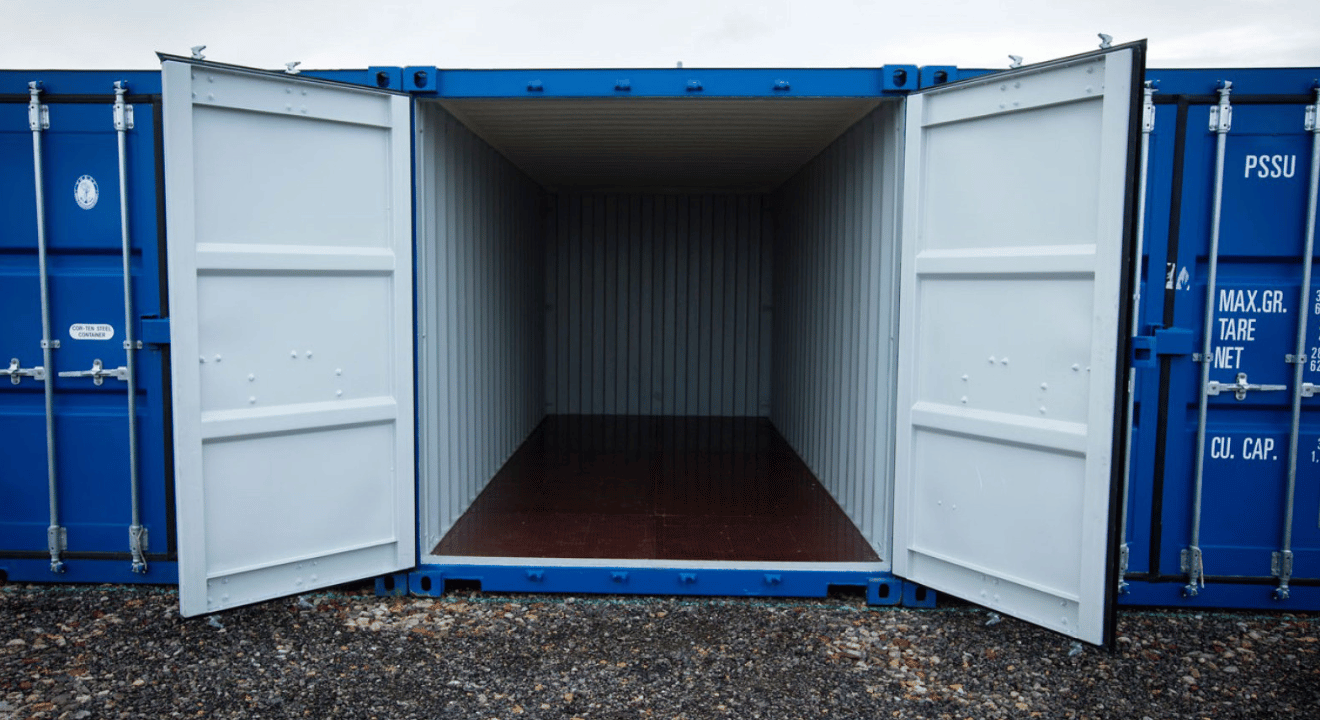
Drive-up containers are weather-resistant steel units you park beside and load straight from the vehicle. They come in 6ft, 8ft, and 10ft, and they're sized by length rather than floor area, so the comparisons below line each one up against its indoor equivalent.
What size storage do I need, by home size?
The best way to find out what storage size you need is by using our storage size calculator here.
How many boxes fit in a storage unit?
If you're storing mostly boxes rather than furniture, the math is simpler. Figure on roughly 10 medium boxes per 10 sq ft when they're stacked properly.
That gives you some easy anchors. A bedroom's worth of boxes, around 20 to 25, fits comfortably in a 20 to 25 sq ft unit. The contents of a decluttered house before a sale, call it 40 to 50 boxes plus a few bits of furniture, wants 50 sq ft or so. Archive boxes for a business stack smaller and denser, so you can usually go a band tighter than you'd expect.
The thing to remember is that boxes stack and furniture doesn't, at least not as neatly. Once you add a mattress, a sofa, or a wardrobe, take your largest item first and build the unit size around that, then slot the boxes into the gaps.
Indoor unit or drive-up container: does the size change?
The size you need is broadly the same either way, but the format changes how easy it is to use.
Indoor units suit a house move, seasonal storage, and anything you'd rather keep inside a building. Choose ground floor for heavy or bulky loads, first floor for boxes and lighter furniture you won't visit often.
Drive-up containers suit anything on wheels, bulky gear, trade stock, or belongings you access regularly with a van, because you load straight off the vehicle with no stairs or corridors. An 8ft container maps to roughly a 35 to 40 sq ft indoor room, and a 10ft container to a packed two-bed apartment or a well-stacked two-bed house. If you're moving in and out often, the container's drive-up access is worth more than a few square feet either way.
The one sizing mistake nearly everyone makes
Going one size too small to save a few euro, then upgrading when it won't all fit. It's the most common call we get.
The fix is to decide whether you need to get into the unit while your things are in it. If you're putting belongings in and closing the door until your move completes, pack it tight and size it snugly. If you'll be coming and going, pulling out the Christmas boxes or a tool you need, go one band up so there's an aisle to reach the back without unloading everything first. That one step up usually costs €20 to €30 a month and saves you an afternoon every visit.
Still not sure? Two ways to get it exact
A guide gets you close, but two things get you to the right unit.
The first is our free storage size calculator. You estimate either by the items you're storing or by the size of your home, and it returns the floor space you need in under a minute. Treat the result as a solid starting point, since the real figure shifts with how well things are packed and stacked.
The second, if your storage is part of a move, is the pre-move survey. The surveyor sizes the unit as part of assessing your move, so collection, storage, and delivery are all costed together and you're not guessing at all. AMC can collect from your home, load straight into storage, and redeliver when you're ready, which removes the van hire and the double handling.
FAQs
Q.What size storage unit do I need for a one-bedroom apartment?
Around 35 to 40 sq ft indoors, or an 8ft drive-up container. That holds a bed and mattress, a sofa on its end, a dresser, a TV unit, and roughly 15 medium boxes. Go to 40 sq ft if you want space to reach things without unloading.
Q.What size do I need for a two-bedroom house?
A full two-bed house fits in about 75 to 85 sq ft, or a well-packed 10ft container. If you want an aisle to walk in and reach the back, size up to 85 sq ft rather than squeezing into 75.
Q.How many boxes fit in a storage unit?
Roughly 10 medium boxes per 10 sq ft when stacked well. So a 20 sq ft unit takes about 20 boxes, and a 50 sq ft unit takes 40 to 50 plus a few small furniture items.
Q.Is it better to get a slightly bigger unit?
If you need to access your belongings while they're stored, yes. One size up gives you an aisle to reach the back without unloading, usually for €20 to €30 more a month. If you're sealing it until your move finishes, pack tight and size snug.
Q.What's the difference between an indoor unit and a drive-up container for the same amount of stuff?
The capacity is similar, around 35 to 40 sq ft indoors equals an 8ft container, and a 10ft container equals a packed two-bed. Containers win on easy drive-up loading; indoor units win on being inside a dry, sheltered building.
Q.Can AMC tell me what size I need?
Yes. Use the free storage size calculator for a quick estimate, or book a pre-move survey if storage is part of a move and the surveyor will size it for you and coordinate the dates.
Get started
AMC's Naas facility has indoor rooms from 16 to 85 sq ft and drive-up containers in 6ft, 8ft, and 10ft, all with 24/7 personal access and full CCTV. Indoor units start from €87.95 a month and containers from €162.36, with no long commitment and the freedom to upsize or downsize anytime.
Not sure which size? Use our free storage size calculator for an estimate in under a minute, or book a unit online. If your storage is part of a move, mention it and we'll coordinate collection, storage, and delivery as one service.
Try the storage size calculator here.