
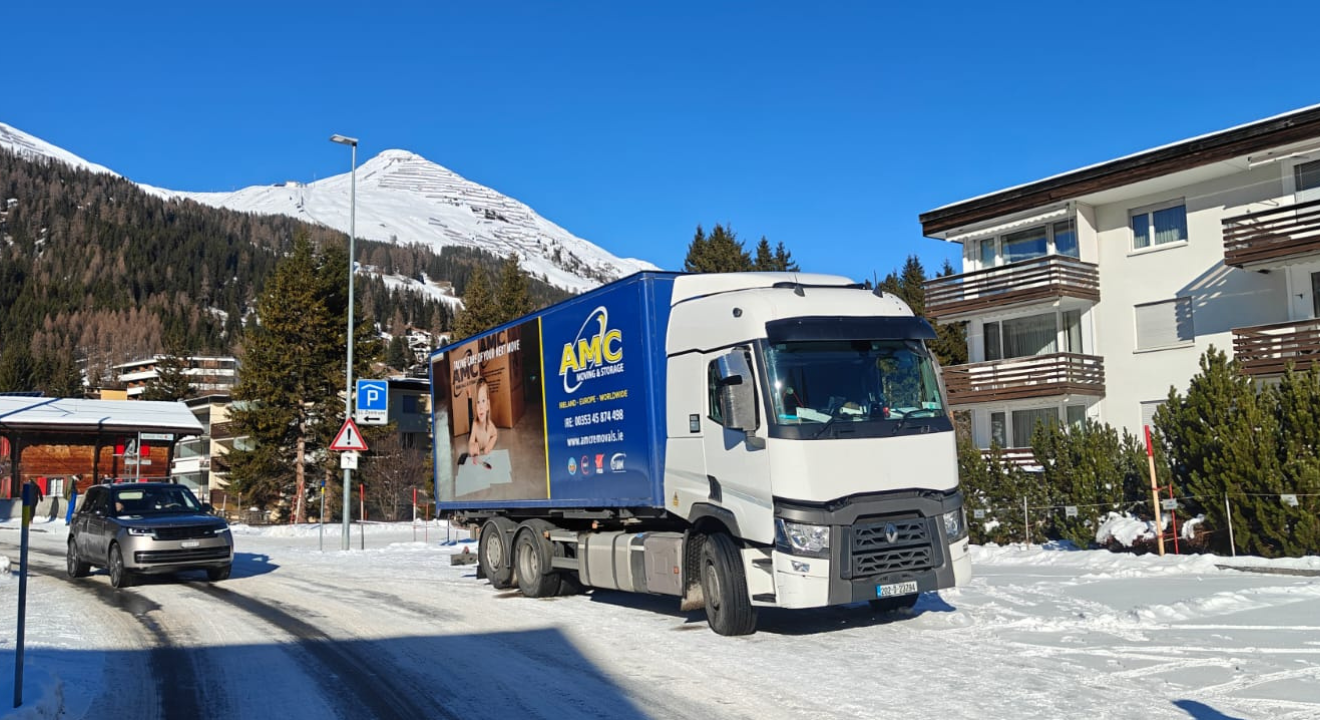
Are you planning on relocating to the land of Alpine mountains, rich chocolate, and zero-minute trains?
AMC makes moving to Switzerland straightforward. We export-pack your household goods in Ireland, handle Swiss customs at Basel or Chiasso, and deliver safely to your new home or apartment anywhere in the Confederation.
Switzerland is small but regionally varied in a way that genuinely matters. The country has four language regions: German-speaking (about 63% of the population, in the north and centre), French-speaking (22%, in the west called Romandy), Italian-speaking (8%, in Ticino in the south), and Romansh-speaking (a tiny minority in the east). The city you pick determines the language you'll need day to day.
Here's where Irish people tend to land.
Switzerland's financial capital and its largest city. Zurich has the strongest job market in the country, finance, banking, tech, consulting, life sciences. Google, Microsoft, and a cluster of major banks have significant operations there. It's also consistently ranked among the most expensive cities in the world for cost of living. A one-bedroom apartment in the city centre runs CHF 2,500-3,500/month. Salaries reflect this, Swiss wages in professional sectors are substantially higher than Irish equivalents, but the adjustment period between arriving and your first Swiss payslip can be tight.
Zurich operates in Swiss German. Hochdeutsch (standard German) works for most professional settings and is understood by everyone, but Swiss German is what you hear in daily life, and it's different enough from standard German that even fluent German speakers need time to adjust.
The international city. Geneva is home to the UN, WHO, International Red Cross, WTO, CERN, and hundreds of other international organisations and NGOs. If you're arriving for a role in international policy, diplomacy, development, or research, Geneva is likely the destination. It's the most English-friendly city in Switzerland by some margin. The international community is so large that English is functional in many professional environments. Geneva operates in French. Cost of living is comparable to Zurich.
The pharmaceutical capital. Novartis and Roche, two of the world's largest pharmaceutical companies, are headquartered here, along with a network of biotech companies and suppliers. Basel is smaller and more manageable than Zurich, sits at the point where Switzerland, Germany, and France meet, and has lower rents than either Zurich or Geneva. If you're arriving in pharma, biotech, or life sciences, Basel is worth serious consideration.
Basel operates in Swiss German, with French spoken widely in parts of the city closest to the French border.
The federal capital. Bern is where the Swiss government sits, and its job market reflects that: federal administration, international organisations, law, and insurance. It's quieter than Zurich and Geneva, significantly cheaper, and has a genuine city feel that doesn't always get the credit it deserves. Swiss German is the working language.
On the shore of Lake Geneva, 45 minutes from Geneva by train. Lausanne has the École Polytechnique Fédérale de Lausanne (EPFL), one of Europe's top technical universities, and a cluster of research, tech, and sports governance organisations (the International Olympic Committee is based there). It operates in French and is cheaper than both Zurich and Geneva. Popular with people who want the Lake Geneva region without the Geneva price tag.
Worth knowing about: Swiss taxation varies by canton. Zug has some of the lowest cantonal and municipal tax rates in Switzerland and has become a hub for tech companies, crypto firms, and high earners who want to be in the Swiss-German heartland without paying Zurich-level taxes. Schwyz, Nidwalden, and Obwalden are similar. If you're arriving as a self-employed person or in a role where you have flexibility on exact location, the canton choice has real financial implications over several years.
Switzerland is landlocked in the centre of Europe. There's no direct ferry. The standard road route from Ireland goes via the UK (Dublin or Rosslare to Holyhead or Pembroke), across to France, and then southeast through France into Switzerland. Depending on destination, goods enter Switzerland via Basel, Geneva, or Lugano.
Your shipment shares a truck with other customers heading in the same direction. Collected in Ireland, consolidated, and driven through to your Swiss door. For studio flats, one or two-bedroom apartments, or anyone not moving a full house, groupage is the right option.
Timeline: 7-12 days from collection. Switzerland is a less frequent route than France or Germany, so groupage wait times can be slightly longer while enough volume accumulates heading in the same direction.
Your own vehicle, your own schedule. For 3-bedroom houses or larger, or when your move date is fixed. Typically 5-8 days door-to-door, depending on origin in Ireland and destination in Switzerland.
Because Switzerland is not in the EU, your shipment has to clear Swiss customs at the border. AMC handles this documentation. You'll need to provide a detailed inventory and the necessary customs exemption paperwork for personal effects (more on this in Section 5). Factor this in when planning your timeline. Customs clearance adds a step that doesn't exist on intra-EU moves.
As an EU citizen moving to Switzerland, you have the right to live and work there under the AFMP bilateral agreement. But you need a residence permit, and the type you get depends on your circumstances.
For stays of less than 12 months. If you're arriving on a fixed-term contract of less than a year, this is typically what you get. L permits are tied to your employer and don't allow the same freedom of movement as a B permit.
The standard permit for most people arriving for work, for indefinite employment contracts, or as self-employed individuals. Valid for 5 years (for EU nationals) and renewable. The B permit is what most Irish people arriving for professional roles will hold for their first years in Switzerland.
Issued after 5 years of legal residence in Switzerland (10 years in some cantons, depending on circumstances). The C permit is permanent and gives you broadly the same rights as Swiss citizens in most day-to-day matters.
Register at your local commune (Gemeinde in German-speaking areas, commune in French-speaking areas, comune in Italian-speaking areas) within 14 days of arrival. Bring your passport, a signed employment contract or proof of self-employed activity, and proof of health insurance. The commune processes your registration and issues documentation that triggers the cantonal migration authority to issue your permit.
If you're arriving as a job-seeker (which is permitted for EU nationals for up to 3 months), you register as job-seeking and convert the permit once you have employment.
Switzerland is not in the EU customs union. Moving your belongings across the Swiss border is technically an import, and it requires customs clearance. The process is more involved than an intra-EU move, but there's a clean exemption available for personal effects.
Used household goods and personal effects that you've owned for at least 6 months are exempt from Swiss customs duties and VAT when you're establishing your primary residence in Switzerland. This is the standard route for people relocating internationally.
What you'll need:
New items, commercially purchased goods, or items in original packaging are not covered by the exemption. Declare them separately; they may attract Swiss VAT (currently 8.1% standard rate).
Vehicles require a separate import process. See Section 6.
Switzerland has its own vehicle registration system and a distinct import process for foreign vehicles. It's more involved than importing into an EU country.
The Swiss equivalent of the NCT. All imported vehicles must pass an MFK inspection before they can be registered with Swiss plates. The inspection checks safety, lights, emissions, and Swiss-specific standards. Some Irish cars need minor adjustments, headlight alignment in particular (same issue as Germany: Irish cars dip left for driving on the left; Swiss roads are on the right). Book this at a canton-approved inspection station.
Swiss registration process:
Applies to trucks, not private cars. You won't pay this on your personal vehicle, but it's why road freight to Switzerland costs a bit more than equivalent French or German moves, AMC's trucks pay this when transiting Swiss territory.
One practical consideration: Switzerland has extremely low speed limits in some areas, very specific rules around winter tyres (some cantons require them in certain conditions), and strictly enforced parking regulations. It's not a place to arrive with a car and wing it. Get insured, get registered, and get the local rules sorted in the first week.
Swiss health insurance is compulsory. Every resident of Switzerland must have basic health insurance (Grundversicherung in German, assurance de base in French) within 3 months of arrival. Coverage is backdated to your date of arrival, so any costs incurred in those first months are covered once you register, but don't leave it to the end of the 3 months.
Unlike most European public health systems, Switzerland's basic insurance is provided by private insurers (called Krankenkassen). The basic package is standardised by law, every insurer must cover the same core treatments. You choose based on price, supplementary options, and the provider networks that work for you.
Premiums vary significantly by canton (healthcare costs differ across regions) and by chosen franchise (deductible). The minimum annual franchise is CHF 300; you can choose a higher franchise (up to CHF 2,500) to reduce your monthly premium. The tradeoff: higher franchise means more out-of-pocket cost when you do need care.
Approximate monthly premiums for standard adult coverage: CHF 350-500/month depending on canton and franchise level. Zurich and Geneva are more expensive; rural cantons are cheaper.
If your income is below a certain threshold, you can apply for cantonal premium subsidies. The system works differently in each canton, check with your Gemeinde or commune after you've registered residency.
The basic package covers a solid standard of care, but many people add supplementary insurance for things like private hospital rooms, dental (not covered by basic), alternative medicine, or better international coverage. This is optional and priced separately.
Switzerland uses a tiered system. For standard models (Hausarztmodell), you register with a Hausarzt (GP) who acts as your first contact and refers you to specialists. Alternative models (Telemed, HMO) involve calling a medical helpline first or using a network clinic. Choosing a model with a designated GP or gatekeeper typically lowers your premium.
Switzerland runs on precision. The admin sequence matters. Here's the practical order for an Irish person arriving in Switzerland.
Go to your local Gemeinde, commune, or comune within 14 days of arrival. Bring your passport, proof of address (lease or temporary accommodation confirmation), and employment contract or proof of economic activity. You'll receive an Anmeldebestätigung (registration confirmation). Keep copies. Everything else flows from this.
Use the Priminfo database (priminfo.admin.ch) to compare premiums across all approved Krankenkassen in your canton. Apply online. Most insurers process applications quickly. Your insurance starts from your date of arrival, not your application date.
You need one. Swiss landlords require a Swiss IBAN for rent, and Swiss payroll pays into Swiss accounts. PostFinance (the Swiss Post's banking arm) is the most accessible for new arrivals with limited documentation. UBS, Credit Suisse (now merged into UBS), Raiffeisen, and cantonal banks are the main alternatives. Neobanks like Neon or Yuh work well while you're getting the full account set up.
The AHV (Alters- und Hinterlassenenversicherung) is the Swiss state pension and social insurance system. Your employer typically initiates this registration, but self-employed people and those arriving without immediate employment need to register at the cantonal AHV compensation fund. Your AHV number is the equivalent of your Irish PPS number and is used across most government interactions.
Within 3 months of establishing residency. See Section 6 for the full process.
Irish driving licences (EU licences) are valid in Switzerland. Once you establish Swiss residency, you have 12 months to exchange your Irish licence for a Swiss one at the cantonal road traffic office. The exchange is direct. No retest for an Irish licence holder.
Switzerland is a longer, more complex route than France or Germany. The road distance, the customs step, and the LSVA transit cost all contribute. These figures are a guide; your quote depends on a survey.
Prices are for collection in Ireland, road freight through France, Swiss customs clearance, and delivery to your Swiss address. Packing service, vehicle transport, customs documentation support, and specialist items quoted separately.
A. Groupage: 7-12 days from collection. Dedicated truck: 5-8 days. Budget an extra day or two for Swiss customs clearance compared to an intra-EU move.
A. No. As an Irish citizen (EU national), you can enter and live in Switzerland under the bilateral Agreement on Free Movement of Persons. You don't need a visa. You do need a residence permit. Register at your local commune within 14 days of arrival and the permit process starts there.
A. Yes, relative to Irish health costs. Budget CHF 350-500/month for basic Krankenkasse coverage depending on your canton and franchise choice. It's higher than equivalent EU public systems, but the quality of care is correspondingly high. Lower-income residents can apply for cantonal premium subsidies.
A. Yes. All imported vehicles must pass an MFK inspection before Swiss registration. Book this at a cantonal inspection station once you arrive. Headlight adjustment for left-hand-drive vehicles is a common requirement.
A. It depends on where you're based. Zurich, Bern, and Basel are Swiss German. Geneva, Lausanne, and the west of the country are French. Lugano and Ticino are Italian. English is widely spoken in professional environments in all major cities, but daily life dealing with your commune, your landlord, the Krankenkasse goes faster in the local language.
A. AMC has storage in Ireland. We hold your shipment and deliver once you have a confirmed Swiss address. Let us know at booking, not the week before the truck is due to leave.
A. Yes, or someone you trust. We won't leave goods unattended at an unoccupied property. If you're flying to Switzerland ahead of the truck, confirm the delivery date to one where you're on the ground.
A. Book a survey: in-person if you're in Leinster, video call from anywhere else. We'll assess the volume, go through your options, and send a written quote within 48 hours.
Instant Online Booking. Choose your size, book in minutes & move in the same day.
.png)
.jpg)
