
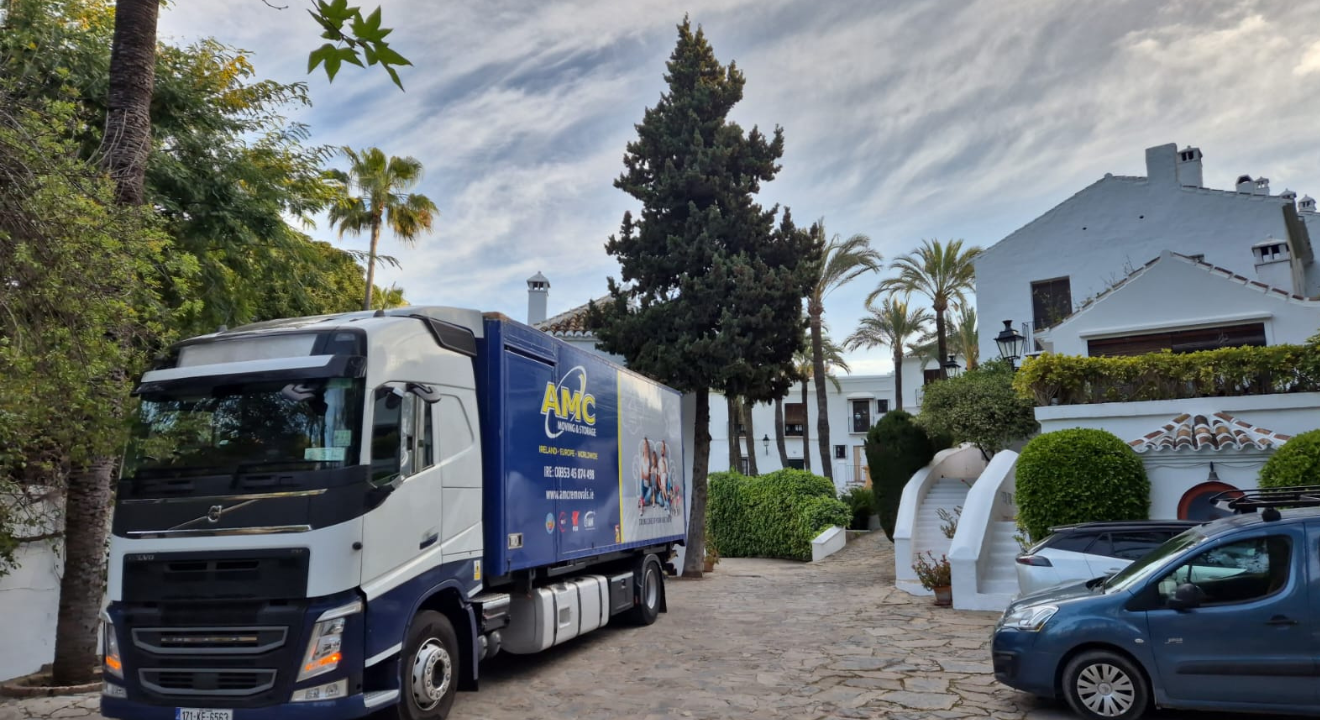
Dreaming of life in the Algarve or a tech role in Lisbon? AMC makes moving to Portugal effortless. We collect your household goods anywhere in Ireland, pack them to export standard, and deliver them safely to your new Portuguese address, be it seaside villas or city apartments.
A few years ago, Portugal was a retirement destination. You moved there when you were done working. That's no longer the reality.
The Irish people moving to Portugal in 2025 and 2026 are remote workers in their 30s, young families who've done the maths on housing costs, and professionals who realised they could do their Dublin job from Lisbon for a third of the rent. The profile has changed completely.
Three things are driving it.
Cost of living. A two-bedroom apartment in Lisbon costs roughly what a one-bedroom in Dublin does. Outside Lisbon (Porto, the Algarve, the Silver Coast) costs drop further. Groceries, eating out, and utilities run noticeably cheaper across the board. For families especially, that gap compounds fast.
Climate. Around 300 days of sunshine a year in most of Portugal. This sounds like a cliché until you've lived through a third consecutive Irish winter.
The NHR tax regime. Portugal introduced a Non-Habitual Resident programme that offered significant tax benefits to new residents for 10 years. The rules have been updated (it's now called IFICI), but the principle remains: Portugal actively wants skilled workers and retirees to relocate, and it has structured its tax system to make that attractive. If you're a remote worker or self-employed, this is worth understanding properly. Talk to a tax adviser who knows both Irish and Portuguese law before you move.
This isn't a trend that's peaking. The number of Irish residents in Portugal has been growing year on year.
Portugal is a small country, about the size of Ireland. But the experience of living in Lisbon, Porto, the Algarve, and the Silver Coast is different enough that the choice genuinely matters.
Lisbon is the obvious choice for people relocating for work or maintaining a career remotely. It has a growing tech sector, good co-working infrastructure, strong public transport, and a large international community that makes settling in faster. The downside: it's the most expensive city in Portugal by some margin, and rents have risen sharply over the last 3 years. If you're comparing Dublin rent to Lisbon rent, the gap has narrowed. You'll still save money, but less than you might expect.
Areas that work well for Irish families: Cascais, Sintra, Almada, Setúbal. All within commuting distance or easy remote-work reach of Lisbon, with more space for less money.
Porto is where Lisbon was about 5 years ago. More affordable, smaller, genuinely beautiful, with a real city feel rather than a resort. The tech and creative sectors are growing. Rents are lower. The food and wine are, frankly, better. Irish people who want Lisbon's energy without Lisbon's prices often end up in Porto. The Vila Nova de Gaia side of the river is particularly popular with families.
The retirement corridor. Not exclusively, younger people are moving here too, particularly remote workers who want coast and space. But the Algarve has the most established British and Irish expat infrastructure: English-speaking GPs, international supermarkets, expat social clubs, international schools. Towns like Lagos, Tavira, Vilamoura, and Carvoeiro have significant Irish communities. Faro airport has direct flights to Dublin and Cork.
The area between Lisbon and Porto, Óbidos, Peniche, Nazaré, Caldas da Rainha, has quietly become one of the most popular spots for Irish families. Lower prices than Lisbon, good access to international schools, and a slower pace. Peniche in particular has become well-known among surfers and younger families.
The interior. Massive farms, cork forests, medieval towns, and very few other foreign residents. If you want genuine rural Portugal and don't mind being an hour from a major city, the Alentejo offers property and cost of living figures that feel almost unreal compared to Ireland. Not for everyone, but worth knowing about.
Ireland to Portugal is a long road haul: around 2,200 km from Dublin to Lisbon via the UK and France. It's entirely doable by road. And for most moves, road freight is the right choice.
Groupage (part load)
The most common option for moves from Ireland to Portugal. Your belongings share a truck with other customers' shipments going in the same direction. Collected in Ireland, consolidated at a depot, and delivered to your door in Portugal. Typically 7-14 days from collection.
This works well for studio flats, one-bedroom apartments, or anyone not moving an entire house. For couples or singles moving the contents of a rented Dublin apartment, groupage almost always makes more sense than booking a dedicated truck.
Dedicated truck
Your own vehicle, your own load. Right for larger moves: 3-bedroom houses, people who need tight delivery windows, or moves that include bulky items like pianos or large garden furniture. Faster (around 5-7 days) and more expensive.
Sea freight
Less commonly used for Ireland-Portugal given how competitive road freight is, but worth knowing about. A full container from Cork or Dublin to Leixões (Porto's port) or Setúbal (near Lisbon) takes around 3-4 weeks. Sea freight makes sense for very large moves where budget matters more than timeline, or when you're shipping a vehicle alongside household goods and want to keep costs down.
Portugal is AMC's fastest-growing destination. Demand is up. Summer slots fill well ahead. If you're planning a move between May and September, booking 8-10 weeks out is the right call.
8-10 weeks before your move date
4-6 weeks before
2-4 weeks before
Moving week
Portugal is an EU country. Moving household goods from Ireland (also EU) should be relatively clean from a customs perspective. Personal effects and household goods you've owned for more than 6 months are generally exempt from import duties and VAT when moving your primary residence.
What you'll need:
Items that are new, still in original packaging, or commercially purchased don't qualify for the relief. Declare them separately.
One thing worth checking: if you're coming from a rental property in Dublin, get written confirmation of your tenancy end date. Portuguese customs occasionally request proof that the Irish address was your primary residence, not just a registered address.
Vehicles are not covered by household goods relief and require their own import process. See below.
Portugal has two taxes on vehicle import that catch people off guard.
ISV (Imposto Sobre Veículos) — a one-time vehicle registration tax based on engine size and CO2 emissions. For a typical 5-year-old family car, this runs anywhere from €1,500 to €5,000+. Higher-emission and larger-engine vehicles pay significantly more.
IUC (Imposto Único de Circulação) — the annual road tax, also based on engine size and emissions.
If your car is more than a few years old and has a smaller engine, the costs are manageable. For newer or larger vehicles, it's often worth selling before leaving Ireland and buying locally once you arrive. Portuguese car prices are broadly comparable to Irish prices, and you avoid the import taxes and re-registration process entirely.
If you decide to bring the car:
AMC can transport your vehicle as part of your removal, or separately. We quote for vehicles alongside household goods.
Ireland and Portugal are both EU countries, and Ireland is listed for pet travel, so the process is more straightforward than moving a pet outside the EU.
Your pet needs:
Dogs entering Portugal from some countries also require tapeworm treatment — check the current requirements with your vet before travel, as these can change.
Pets typically travel by air: in the cabin for small animals (airline rules vary on size limits), or as cargo for larger dogs. AMC doesn't transport live animals, but we can point you toward specialist pet relocation companies we've worked alongside on previous Portugal moves.
Portugal doesn't have restrictions on specific dog breeds at a national level, though some municipalities have their own rules. Worth checking locally once you've decided where you're settling.
We handle the removal. Here's a plain-language overview of the admin side. For anything complex (tax residency, NHR/IFICI application, visa), talk to a professional who knows both Irish and Portuguese law.
NIF (Número de Identificação Fiscal)
Your Portuguese tax number. You need this for almost everything: opening a bank account, signing a lease, buying a car, setting up utilities. Apply at the Portuguese consulate in Dublin before you leave. This is the most time-efficient approach. You can also apply at a Portuguese Finanças office on arrival, or through an appointed fiscal representative.
Residency Registration
EU citizens can live in Portugal without a visa. If you plan to stay longer than 3 months, you need to register at the local Câmara Municipal (local council) and apply for an AIMA registration certificate (the body that replaced SEF in 2023). You'll need proof of address, NIF, and proof of income or employment.
NHR / IFICI Tax Regime
Portugal's non-habitual resident programme has been updated. The original NHR status (which offered flat-rate tax on foreign income for 10 years) closed to new applicants at the end of 2023. The replacement scheme, IFICI, applies to specific categories of workers: technology, scientific research, certain professions. If you are a remote worker or self-employed, get specialist tax advice on whether you qualify and what it means for your Irish income. This is worth doing before you move, not after.
Portuguese Healthcare
EU citizens registered as Portuguese residents are entitled to use the SNS (Serviço Nacional de Saúde): the public health system. Register at your local health centre (Centro de Saúde) with your residency registration and NIF. Most expats use a combination of public and private healthcare. Private health insurance runs significantly cheaper than equivalent Irish plans.
Portuguese Bank Account
Open a Portuguese account before your other admin, ideally. Most paperwork requires a local bank account or IBAN. Millennium BCP and Santander Totta are frequently used by expats. Some Irish banks (including some neobanks) let you open a Portuguese-IBAN account remotely. CGD (Caixa Geral de Depósitos) is the state bank with the most branches in rural areas.
These figures are a guide. Your actual quote depends on a survey: volume, access, packing requirements, and timeline all affect the final number.
Prices are for road freight, collection in Ireland, delivery to Portugal. Packing service, vehicle transport, and specialist items are quoted separately.
Portugal is a longer run than Spain. The extra distance adds to groupage timelines and dedicated truck costs compared to a Spanish move. Factor in 7-14 days for groupage, 5-7 days for a dedicated truck.
A. Costs depend on volume, access, and timing. Fill in our quote form for an obligation-free video survey.
A. After the survey we total your goods in cubic feet or metres and assign the right truck or container size, so you only pay for the space you need.
Absolutely. We can deliver boxes and materials a week or more before loading. See our various packing materials & sizes here.
A. Transport and packing charges are payable before departure. Storage fees are billed monthly while goods stay in store.
A. You can, but self-packed cartons aren’t covered by insurance. Professional packing gives you full cover.
A. We’ll store your goods in Naas or in our partner warehouse in Portugal until you are ready. Learn more about storage here.
A. Groupage: 7-14 days from collection. Dedicated truck: 5-7 days. Sea freight: 3-5 weeks.
A. Very common. If you're flying over to sort housing before the truck arrives, we hold your shipment and deliver when you're ready. Let us know during booking, not the week before.
A. We deliver door-to-door across Portugal, including the Algarve, Porto, Lisbon, and the Silver Coast. If you're in a rural area or a property with difficult access (steep driveways, narrow roads), tell us at the survey stage so we can plan the right vehicle.
A. It can be. Lisbon apartment buildings (particularly old ones) often have small lifts or no lift at all, with narrow staircases. We've done enough Lisbon moves to plan for this. Tell us about your building at the survey and we'll account for it.
A. Yes, or someone you trust needs to be there to accept the delivery and sign the inventory. We won't leave goods unattended at an unoccupied property.
A. Book a survey: in-person if you're in Leinster, video call from anywhere else. We'll assess the volume, go through the options, and get you a written quote within 48 hours.
Instant Online Booking. Choose your size, book in minutes & move in the same day.
.png)
.jpg)
